
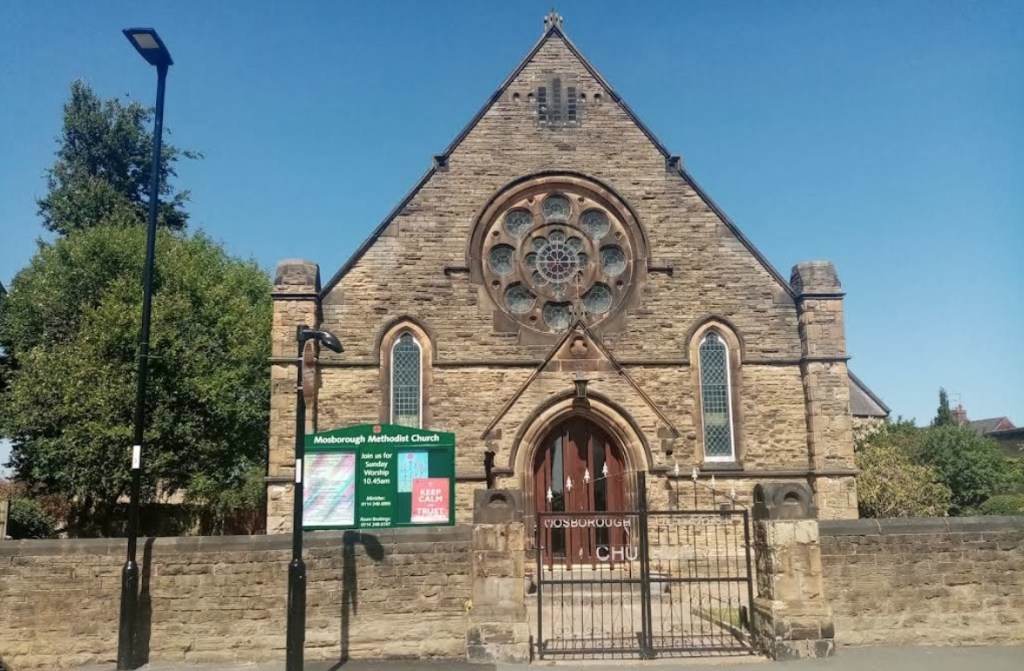
Mosborough Methodist Church on Chapel Street is the village’s late-Victorian Wesleyan chapel—solidly built in local stone, modest in scale, and still busy with worship and community life today. Its story sits alongside Mosborough’s other nonconformist landmarks, especially the Primitive Methodist chapel on Queen Street, and helps explain how Methodism shaped village life from the 19th century into the present.
Wesleyan Methodists were active locally by the 19th century; in 1888 the congregation raised a new chapel on Chapel Street (later commonly called “Trinity”). Surviving records and centenary material confirm the 1888 date and continuous activity through the 20th century. Leaders’ Meeting minute books survive from 1891 to 1968, and a centenary booklet—Mosborough Methodist Church: a hundred years, 1888–1988—was produced in 1989.
Around 1900 the church expanded its footprint with a substantial two-storey Sunday School/Church Hall just round the corner on Cadman Street. The hall’s materials and detailing were chosen to match the chapel, giving the site a coherent “campus” feel.
Stand at the gates on Chapel Street and the façade tells you almost everything about late-Victorian Wesleyan taste:
- A simple gable-front composition in coursed local sandstone, with a centred arched doorway and flanking lancet windows.
- Above the door, a prominent wheel (rose) window—a favourite Nonconformist motif of the 1880s–90s—signals the main worship space within.
- The side elevation continues the theme with tall lancets and shallow buttressing; the whole is sturdy rather than showy, built for durability and good acoustics.
When the various Methodist streams united nationally in 1932, the Wesleyan chapel on Chapel Street became Mosborough Methodist Church within what is now the Sheffield Circuit—the arrangement you’ll still find today.

 The Mosborough One-Place Study